Amazon #1 Bestseller • Hot New Release
Indian Epics. Life Lessons.

HAVE YOU FOUND YOUR SANJIVANI YET?

31 Untold and Rare Stories from Indian Epics, revealing how deities and sages survived—plus actionable steps to help you thrive beyond life’s hardest moments in Self-Image, Relationships, Career, and Academics.

You’ve done everything right. You have read Western self-help books, listened to motivational podcasts, and kept daily journals. Yet when life reached its rawest moments, a void remained.

“Do you know that the answers you seek were written millennia ago in ancient India? Our Rishis mapped every shade of human suffering and provided the precise Dharmic path to overcome it.”
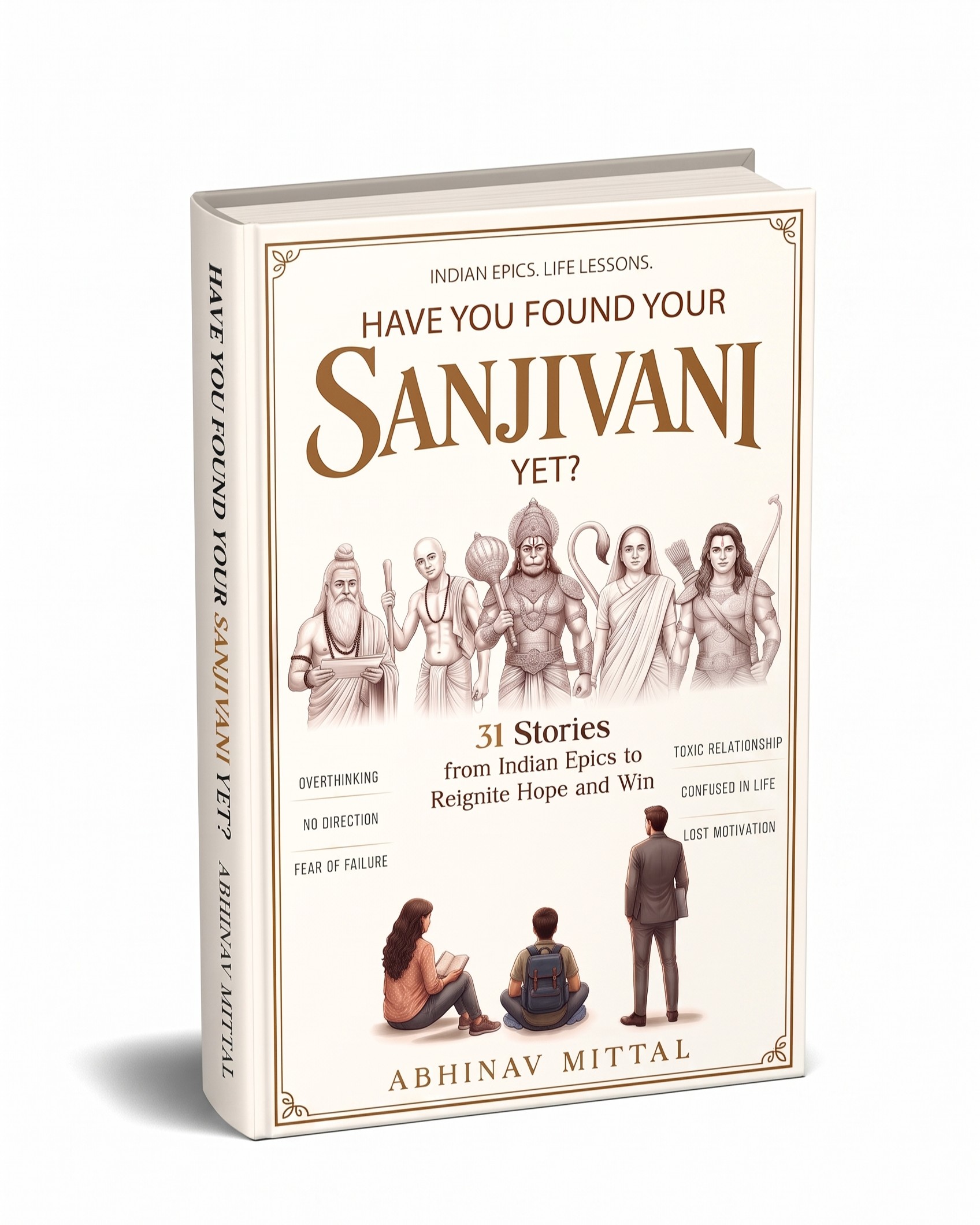
Have You Found Your Sanjivani Yet? 31 Stories from Indian Epics to Reignite Hope and Win by Abhinav Mittal — #1 Amazon Bestseller
INDIAN EPICS. LIFE LESSONS.
HAVE YOU FOUND YOUR
SANJIVANI
YET?
31 Stories
from Indian Epics to
Reignite Hope and Win
OVERTHINKING • NO DIRECTION • FEAR OF FAILURE
TOXIC RELATIONSHIP • CONFUSED IN LIFE • LOST MOTIVATION
ABHINAV MITTAL
Bestsellers Hot New Releases
#1

Have You Found Your Sanjivani Yet?: 31 Stories from Indian Epics to Reignite Hope and Win

★★★★★  |  Paperback  |  ₹499.00

Why an AI Strategy & ROI Leader Wrote Sanjivani

Three years of after-hours research into how our ancestors survived life’s breaking points

❖

Most of my professional world knows me for my work in AI strategy, governance, and enterprise ROI. Yet for three years, after work hours, I was quietly writing my third book—a work that reached #1 Bestseller in its category on Amazon India within three days of its release by Notion Press.

The seed of SANJIVANI was planted as I watched people close to me reach breaking points: a founder whose startup collapsed, a vice president pushed out by office politics, a college student crushed by exam pressure, and a friend navigating a painful divorce.

In those moments, many Western self-help books felt too clinical for the pain we experience as human beings. They could not speak to Indian family expectations or the cultural weight of failure in our homes.

So I spent three years researching more than a hundred stories across our Indian epics—the Ramayana, the Mahabharata, the Upanishads, and the Puranas—to uncover how our revered deities and sages survived their darkest hours, not through miracles or divine boons, but through human grit and strategy. In this book, those lessons are distilled into 31 crisis-specific stories, each concluding with a concrete resilience protocol.

“I did not write SANJIVANI for the sake of writing a bestseller. I wrote it with a single mission: to bring hope, strength, and a clear path forward when life feels heaviest. The true fruits of our labor are seen only once they grow into a tree that can offer shade to others.”

Read the book, reflect on your own journey, and if you find a new direction within these pages, share it with someone you care for.

When Our Heroes Stood in the Dark

Six of the 31 turning points inside the book

✦

SRI HANUMAN

Stood on a rooftop in Lanka, ready to end his life.

BHARTHARI

Discovered his queen had given away his gift of immortality to her secret lover.

GARGI

Challenged the greatest scholars in an assembly that wanted her silent.

ARJUNA

The world’s greatest warrior hid his mighty hands under silk bangles to survive.

DRONACHARYA

Was humiliated because he could not afford to feed his child.

ASHTAVAKRA

Was mocked for his physical deformities in the royal court.

31 MODERN CRISES. 4 LIFE DOMAINS.

Open directly to the chapter that names your pain.

✦

1. SELF-IMAGE

8 Chapters • Despair, Insecurity & Rebuilding
  • I Feel Like Giving Up (Hanuman)
  • I Am Completely Alone (Ekalavya)
  • I Am Not Good-Looking (Ashtavakra)
  • I Wasted My Life (Valmiki)

2. RELATIONSHIPS

6 Chapters • Family Pressure, Heartbreak & Duty
  • Partner Cheated on Me (Bharthari)
  • Crushed by Family Legacy (Arjuna)
  • Partner Married to Job (Lopamudra)
  • Single Parent Survival (Kunti)

3. CAREER

12 Chapters • Workplace Politics, Failure & Comebacks
  • Fired from My Job (Kubera)
  • Insecure Manager (Brihannala)
  • My Startup Failed (King Nala)
  • Only Woman in Room (Gargi)

4. ACADEMICS

5 Chapters • Exam Stress, Learning Styles & Focus
  • I Failed in School (Panini)
  • Missed the Cutoff (Lomaharshana)
  • Mocked for Being Weird (Kanada)
  • I Am a Slow Learner (Indra)

Complete Table of Contents: All 31 Life Crises

Each chapter opens with a modern life crisis and closes with a concrete four-to-five-step resilience protocol inside the book.

Section One: Self-Image (Chapters 1–8)

  1. I Feel Like Giving Up – HanumanWhen exhaustion, failure, and despair push you to the edge of quitting
  2. I Am Completely Alone And Ignored – EkalavyaSucceeding without a network, mentor, or elite institutional backing
  3. I Am Not Good-Looking – AshtavakraWhen you are judged or mocked for your physical appearance
  4. I Wasted My Life – ValmikiFor late bloomers waking up at 40 or 50 with deep career or life regret
  5. I Can Never Be Successful – SugrivaBreaking the cycle of chronic self-doubt and learned helplessness
  6. I Have A Physical Disability – ArunaNavigating a chronic health crisis, injury, or physical limitation
  7. I Feel Like A Burden To My Family – DirghatamasWhen illness, age, or unemployment makes you feel unwanted at home
  8. I Am Not Popular – ViduraFor the quiet introvert overlooked in an age of loud self-promotion

Section Two: Relationships (Chapters 9–14)

  1. My Partner Cheated On Me – BharthariRecovering from romantic betrayal, infidelity, and broken trust
  2. I Cannot Live Up To My Family Standards – ArjunaWhen parental comparison and the burden of family legacy crush you
  3. My Partner Is Married To Their Job – LopamudraNegotiating presence and dignity with a workaholic spouse
  4. I Don’t Want To Get Married – SulabhaChoosing solitude, career, or spiritual purpose over marriage pressure
  5. I Am A Single Parent – KuntiRaising children alone while navigating a hostile family environment
  6. I Am Paralyzed By Grief – ParikshitRebuilding life after the devastating loss of loved ones

Section Three: Career (Chapters 15–26)

  1. I Was Fired From My Job – KuberaBouncing back when you lose your title, seat, or role overnight
  2. My Manager Does Not Want Me To Excel – ArjunaSurviving an insecure supervisor who suppresses your talent
  3. My Startup Failed – NalaRebuilding from bankruptcy, lost valuation, and entrepreneurial ruin
  4. I Am The Only Woman In The Room – GargiSpeaking with authority when a biased boardroom wants you silent
  5. I Am Stuck In A Dead-End Job That I Can’t Leave – TuladharaFinding peace and purpose when EMIs and family duties keep you at your desk
  6. I Was Denied Promotion – KartikeyaWhen you hit every KPI and target, yet someone else gets the reward
  7. I Was Rejected For A Job I Was Qualified For – ShukracharyaWhen your dream company passes you over for a conventional candidate
  8. I Am Not From A Rich Family – DronacharyaEscaping the gravity of poverty through undeniable competence
  9. My Products Have No Market – Maya DanavaCreating demand when giants already dominate your industry
  10. I Was Excluded From The Group – KakabhushundiFor the unseen backend builders left out of the inner circle
  11. I Feel Too Small To Fight Back – AstikaStanding against systemic corporate or institutional injustice
  12. My Team Doesn’t Care To Improve – AmarasaktiMotivating a comfortable, unbothered workforce that ignores feedback

Section Four: Academics (Chapters 27–31)

  1. I Failed In School – PaniniFor the backbencher whose analytical mind rejects rote memorization
  2. I Could Not Get Admission In The Top School – LomaharshanaWhen an entrance exam rejection letter makes your future feel over
  3. I Am Mocked For Being Different – KanadaFor the student bullied as a 'nerd' or 'weirdo' for their deep obsession
  4. I Am Obsessed With High Grades – BharadwajaEscaping academic burnout and transitioning from rote marks to mastery
  5. I Am A Slow Learner – IndraWhy questioning deeply and learning slowly builds unshakeable mastery
Order Your Copy on Amazon.in

Author’s Note

Why don’t we turn to our own stories during our moments of crisis?

❖

We all reach seasons when coping stops feeling like a concept and becomes a daily need. Sometimes that need arrives in our own lives. Sometimes it enters through a child, a partner, a parent, a friend, or a colleague whose pain has come into the room and refuses to leave. Yet coping, as a life skill, is rarely taught in a form people can hold when they are hurt. Much of what fills the self-help shelf comes through Western psychology, clinical language, or systems that ask for distance at the very moment a person is struggling to stay upright.

I grew up surrounded by stories from Hinduism, and one question kept returning. With over a million deities, countless stories, and centuries of reflection on grief, shame, fear, failure, longing, exile, pride, and recovery, why don’t we turn to these stories during our moments of crisis?

That question led me to more than a hundred stories. What stayed with me was seldom the miracle or the battlefield. It was the relatable moments of doubt and resilience. Hanuman on a rooftop in Lanka, pausing in deep reflection. Arjuna unable to raise his bow. Ashtavakra standing in a royal court with a body the world had mocked and a mind it could not shake. In those moments, the distance between the divine ideal and the ordinary person began to fall away.

This book gathers 31 stories across four domains of life: career, self-image, relationships, and academics. Each story closes with a short protocol, four or five actions drawn from the story itself. I did not place them there as a lecture. They are meant to provide practical guidance when you are too exhausted to think and simply need a clear path forward.

— Abhinav Mittal

Read Chapter 1

A complete preview from Section One: Self-Image

✦
Chapter 01 • Self-Image

I Feel Like Giving Up — Hanuman

The Rooftop of Despair: When You Are Ready to Quit

The Ocean of Despair

There comes a moment in every ambitious journey when the road simply ends. You have tried everything. You have exhausted your resources. You have toiled relentlessly through the night. You have prayed, strategized, and executed. And yet, the result is zero.

One dream stalled before it could begin, another plan collapsed under your hands, and the relationship you kept trying to mend stayed broken. Then a terrifying silence settles in. It feels deeper than failure, harder to name, and heavier to bear. It is the silence of abandonment. The mind spirals from "I failed" to "I am a failure" to "There is no point in living."

If you are currently standing on that precipice of despair, staring at the ruins of what you had so fiercely hoped for, you are standing right next to Sri Hanuman.

We think of Hanuman as the embodiment of unshakeable strength (Bajrangbali). We imagine him lifting the Sanjeevani mountain, burning Lanka, and tearing open his chest. But in the Sundara Kanda (the fifth book of the Valmiki Ramayana), there is a chapter that is rarely discussed in popular culture. It is the chapter where the invincible hero, Hanuman, falls into a deep, suicidal despair. His story teaches us that despair is not a sign of weakness; it is the final test before the breakthrough.

The Leap Before the Silence

Just hours earlier, Hanuman had performed the greatest physical feat in history. He had leaped across the ocean, covering 100 Yojanas in a single bound. He had overcome Mainaka (the Mountain of Comfort) by refusing to rest, Surasa by using his intellect, and Simhika by destroying the envy that tried to pull him down.

Landing in Lanka as the divine emissary (Doota) of Lord Rama, he shrank to the size of a small cat (Vrishadamsaka) and searched Ravana’s golden corridors angula-prati-angula (inch by inch)—the palaces, bedrooms, kitchens, armories, and gardens. He saw Ravana sleeping, but he did not see the one face he came for. He did not find Mata Sita.

The Collapse of the Mission & The War Within

Standing on the granite edge of a moonlit rooftop, the realization hit him like a physical blow: She is not here. For the first time in his life, Hanuman faced a problem that his physical strength could not solve. His mind fractured under catastrophic doubts: What if she fell into the ocean? What if Ravana killed her? If I return to Kishkindha without news of Mata Sita, Rama will die of a broken heart, Lakshmana will die of grief, and Sugriva will die of shame.

Crushed by the fear that his unfulfilled mission would wipe out the entire Raghu dynasty and the Vanara race, Hanuman—the Immortal One (Chiranjivi)—began to contemplate ending his life: Shall I jump into the fire? Shall I starve myself to death (Prayopaveshana)? Shall I drown myself in the ocean?

The Philosophy of Survival

Then, a flash of wisdom rose from his own Buddhi (intellect). He realized that destroying one's life is an act of Tamas (darkness). As long as he remained alive, there was a non-zero chance of finding her; if he died, the chance became zero.

Stepping back from the ledge, Hanuman made a conscious, deliberate choice to keep searching where he had not yet looked. With a calm mind, he noticed a cluster of trees in the distance that he had missed in his panic: the Ashoka Vatika. Entering the grove, beneath a Simshapa tree surrounded by Rakshasis, he found Mata Sita.

The despair on the rooftop was an illusion created by exhaustion. The answer was just a few hundred meters away, hidden behind a wall of trees. The real victory of the Sundara Kanda happened on that rooftop, when he chose to stay alive for one more hour.

The “Rooftop Protocol”: How to Survive the Urge to Quit
  1. The “Anirveda” Mantra (Despair is a Luxury): Hanuman realized that despair (Nirveda) drains life-force (Prana). Treat the urge to quit as a temporary fluctuation of an exhausted mind, not a permanent truth.
  2. Check the “Adrishta Kona” (The Unseen Corner): Hanuman thought he had searched "everywhere," yet he missed the Ashoka Vatika. There is always an untested strategy, a mentor you haven't called, or an angle your panic hid from view.
  3. Shift from “Hero” to “Instrument” (Nimitta-matram): Hanuman’s pain came from ego ("I failed"); his strength returned through service ("I serve Rama"). Stop making the setback about your reputation; focus on the mission.
  4. The “Jivan Bhadrani” Rule (Live to See the Good): Quitting guarantees zero results. Staying in the arena guarantees a non-zero probability of breakthrough.
  5. One More Try (The Rule of 100): Hanuman searched 99% of Lanka and found nothing. The victory waited in the final 1%. Take one more step today.

The Vedic Verdict: The darkest hour is not the end of the story; it is the step before the breakthrough. Live for the next hour.

Original Scriptural Sources for Chapter 1
सागरानूपजे देशे बहुमूलफलोदके। चितिं कृत्वा प्रवेक्ष्यामि समिद्धमरणीसुतम्॥ "In a region near the sea, with abundant roots, fruits, and water, I will build a funeral pyre and enter the blazing fire." — Valmiki Ramayana, Sundara Kanda 13.41
विनाशे बहवो दोषा जीवन् प्राप्नोति भद्रकम्। तस्मात् प्राणान् धरिष्यामि ध्रुवो जीवति संगम:॥ "There are many faults in destroying one's life. Only by living can one see good things. Therefore, I shall hold on to my life; for the living, meeting with good is certain." — Valmiki Ramayana, Sundara Kanda 13.47
अनिर्वेद: श्रियो मूलमनिर्वेद: परं सुखम्। भूयस्तत्र विचेष्यामि न यत्र विचय: कृत:॥ "Perseverance (non-despair) is the root of all prosperity. Non-despair is the highest happiness. Therefore, I will search again in those places where I have not searched yet." — Valmiki Ramayana, Sundara Kanda 12.10

Read the remaining 30 stories and protocols inside the full edition of SANJIVANI.

Order Paperback on Amazon.in

Frequently Asked Questions

How to use this book during a difficult season of life

❖
How is SANJIVANI different from traditional Indian mythology or Western self-help books?

Traditional mythology books usually open with ancient lore and end with broad philosophical reflections, while Western self-help books often feel clinical and disconnected from Indian family expectations. Have You Found Your Sanjivani Yet? opens each of its 31 chapters with your specific modern crisis, walks you into the inner emotional turmoil of an epic figure who survived that exact moment through human grit and strategy (rather than divine boons), cites the original Sanskrit verses, and closes with a concrete four-to-five-step protocol.

Which chapters should I read if I am facing a career setback, layoff, startup failure, or office politics?

Section Three (Career) contains 12 dedicated chapters: being fired or pushed out of your role (Lord Kubera, Chapter 15), working under an insecure manager who suppresses your growth (Arjuna as Brihannala, Chapter 16), recovering from startup failure or bankruptcy (King Nala, Chapter 17), being the only woman in a biased boardroom (Gargi, Chapter 18), feeling stuck in a dead-end job (Tuladhara, Chapter 19), being passed over for a deserved promotion (Kartikeya, Chapter 20), and motivating an unbothered team (Amarasakti & Vishnu Sharma, Chapter 26).

Which chapters help students dealing with exam stress, college rejection, or school bullying?

Section Four (Academics) addresses five core student struggles: failing in school because your brain rejects rote memorization (Maharishi Panini, Chapter 27), missing the cutoff for admission into a top college (Lomaharshana, Chapter 28), being bullied or mocked for being different (Maharishi Kanada, Chapter 29), burnout from obsession with high marks (Sage Bharadwaja, Chapter 30), and feeling like a slow learner (Lord Indra, Chapter 31).

Do I need prior knowledge of Sanskrit or Hindu scriptures to read this book?

Not at all. Every story is written in clear, contemporary English designed for modern readers. Original Sanskrit verses from the Valmiki Ramayana, the Mahabharata, the Rig Veda, the Upanishads, and the Puranas are included at the close of each chapter alongside clear English translations for those who wish to explore the primary sources.

About the Author

❖

Abhinav Mittal is an AI Strategy and ROI thought leader, AI governance expert, CXO advisor, and bestselling author with over two decades of leadership across the US, Europe, India, and the Middle East. Based in Dubai, he has led 40+ enterprise transformations, delivering over $100 million in value for Fortune 500 firms, governments, and Tier-1 consulting organizations. A University Gold Medalist, he holds a dual MBA from Great Lakes Chennai and IIT Chicago (Stuart School of Business), alongside a Harvard University leadership credential.

Author of Reduce Cloud Computing Cost and Reduce IT Cost, Abhinav has mentored more than 500 executives, startup founders, and young professionals through demanding career and life transitions. Observing the growing gap between Western self-help frameworks and the lived emotional realities of Indian families inspired his third book, Have You Found Your Sanjivani Yet?—which became a #1 Bestseller in its category on Amazon India within days of release.

Anchored in Vasudhaiva Kutumbakam (वसुधैव कुटुम्बकम् — the world is one family), Abhinav sees himself simply as a lifelong student sharing these timeless, life-saving stories with generations that need them. He welcomes readers at abhinavmittal.com and on LinkedIn.